Vibe Coding 101
How to transform your design ideas into code.
TL;DR
Vibe coding is a fundamental shift in creative development where you act as editor-in-chief, directing AI through high-level intent rather than manual syntax. At Paohaus, we're using tools like Replit Agent for logic and Claude Code for design-integrated prototyping to reach a Proof of Concept faster than ever. This process is rooted in mindful iteration, treating your initial prompts as rough sketches that require constant refinement. While it's a superpower for testing new ideas, we're still firm believers that expert senior developers are necessary to shore up security and ensure a project is truly ready for the real world.
At Paohaus, we’re always looking for ways to bridge the gap between "I have a cool idea" and "Here is a working prototype." Lately, the method we've been using to build that bridge is vibe coding.
If you’ve been keeping up with tech news or browsing designer and developer forums lately, you’ve likely seen the term popping up everywhere. While it sounds like a trendy buzzword, it represents a fundamental shift in how we approach creation. This is a comprehensive guide to help you understand how to leverage it for your own design-led projects.
Mindset Shift
Traditional coding is like working as a ship’s engineer. You have to understand the mechanics of the engine room, knowing exactly how to fix things when they break. It’s technical, precise, and requires you to manage every small detail to keep the vessel moving.
Vibe coding is more like being the ship’s captain. You aren't in the engine room worrying about the specific syntax of async/await logic or CSS grid layouts. Instead, you set the ship's heading and make the big calls. You’re directing the AI to manifest a vision. Your job is to define the goal, set the aesthetic boundaries, and steer the ship. It’s a shift from writing syntax to managing high-level intent.
The Paohaus Vibe Stack
There's a rapidly growing list of tools out there, but our team at Paohaus has narrowed our workflow down to two primary powerhouses:
- Replit Agent: This is our go-to for logic and deployment. Replit Agent is incredible because it handles the entire environment setup for you. If you need to build the "brains" of an application and get it live on a URL in minutes, this is the tool to use.
- Claude Code: We use this for deep, nuanced creative work. One of the best parts about Claude Code is its integration with tools like Figma Make. We can leverage Claude to generate code that directly interacts with our designs, allowing us to bridge the gap between a static canvas and a functional interface seamlessly.
Iteration Loop
Vibe coding is a creative discipline, much like writing or UI design. We think it's best to keep the following philosophy in mind when vibe coding: your first draft is your worst draft. We view vibe coding as a collaborative dialogue between the designer and the AI.
The essential core of this process is mindful iteration. You should never expect the AI to read your mind perfectly on the first prompt. Instead, look at that initial output as a rough sketch. Identify what’s working and what isn't, then refine your instructions to steer the project toward the final vision. It's going to take a little back and forth to get something worthwhile.
The Anatomy of a Vibe Coding Prompt
To get professional results, your prompts need to be structured thoughtfully. Here are the three building blocks we use at Paohaus:
- Context (What and Who): Define exactly what you’re building and who will be using it. This helps the AI understand the necessary utility of the project.
- Aesthetics (Style and Feel): Instead of using vague terms, be descriptive. Tell the AI to "use a minimalist Japanese-inspired aesthetic with soft earth tones and heavy use of negative space" or "a dark-mode cyberpunk vibe with neon accents and high-contrast typography."
- Function (Features and Actions): Clearly list the primary actions a user should be able to take.
Putting it all Together
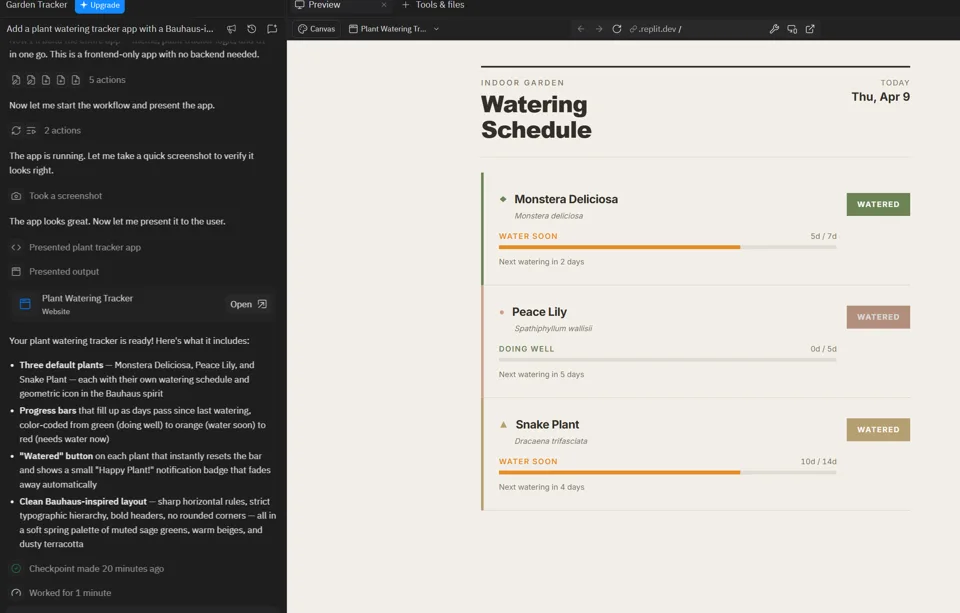
If we wanted to build a working prototype of a watering tracker for plant parents, we'd write a prompt that looks like this:
"Act as a senior frontend developer. Create a single-screen React app for plant parents to track their indoor garden's watering schedules. The design should be clean and Bauhaus-inspired, using a Soft Spring color palette with muted greens and warm beiges. Include a list of three default plants. Each plant should have a 'Mark as Watered' button that, when clicked, resets a progress bar and displays a small 'Happy Plant' notification."
Why Human Touch Still Matters
We're huge fans of vibe coding because it lets us reach proof of concept faster than we ever thought possible. It’s a superpower for prototyping and testing ideas before committing major resources to them.
However, the more we dive into vibe coding the clearer it becomes that vibe coding is not a replacement for professional developers. While the AI can get a prototype running, it often produces code that's inefficient or "bloated." More importantly, AI-generated code can have security vulnerabilities that only an expert human eye can catch.
At Paohaus, we use vibe coding to bring an idea to life so we can see if there’s a spark worth pursuing. Once we know we have a winner, our senior developers take over to shore up the logic, secure the data, and ensure the project is stable enough for the real world. We see it as a partnership where the AI handles the "what if" and the humans handle the actual implementation.
Final Thoughts
The barrier to entry for building your own tools is lower than it has ever been. If you’re a designer with a "what if" sitting in your notes app, we encourage you to jump in and try it. Use vibe coding to see if your idea has legs. Just remember that while the AI provides the speed, your taste and expert oversight provide the quality.